
Have you ever thought, “My students can subtract… until I change the equation around.” Same. When it comes to subtraction skills, most of my students can solve straightforward problems without blinking. But the second I write problems such as 10 – ? = 7 or ? – 3 = 7, they get thrown off. That’s when I realized the issue was not subtraction facts. It was understanding.
As teachers, we know that subtraction is foundational in first grade and beyond. It’s not just about taking away. It’s about understanding change, comparison, and what’s happening in a story. A few years ago, I found the best way to help build my student’s subtraction skills was through word problems.
How Number Stories Support Subtraction Skills
If we want to know whether students truly understand subtraction skills or are just following steps, we have to give them word problems. Because that is where the understanding shows up.
Number stories force students to think about what is happening instead of automatically grabbing an operation. They create mental images. Students can act it out. They can draw it or talk through it.
When students understand the story, their subtraction strategies develop more naturally. Their confidence grows. And here’s the bonus no one talks about enough: their math fact knowledge improves without drill-and-kill worksheets. Understanding first. Fluency follows.

The Types of Subtraction Problems First Graders Need
Before we expect students to “just subtract,” they need exposure to different kinds of subtraction situations. Remember when I said my students struggled with different types of problems, this is why. They had not seen enough types of subtraction problem types. Let’s break them down.
A. Separating Result Unknown Problems
An example of this type of problem would be, Andrea baked 15 cookies. Her sister ate 7. How many cookies are left? These problems feel easiest for students because the action and result are clear. Something happened and we are finding what remains. These problems can be easily modeled with drawings, counters, and even acting them out. Students can quickly jump straight to the equation. This is often where subtraction skills begin to develop.
B. Separating Change Unknown Problems
In this type of problem, although there is still action. For example, Andrea baked 15 cookies. Her sister ate some. Now there are 8 cookies left. How many did she eat? These problems tend to be trickier because now we are missing the middle.
One helpful move is asking what changed and what stayed the same? These types of problems are perfect for math talks and partner discussion because there is more than one way to think about them. Some count up, some subtract, or even use related facts. This is where subtraction skills deepen.
C. Separating Start Unknown Problems
Separating start unknown are the trickiest type of subtraction problem for students to solve. An example of this problem is, Andrea baked some cookies. Her sister ate 7. Now there are 8 cookies left. How many cookies did she bake at first?
In this problem type, students must think flexibly and recognize the total is missing. This realization is huge. It means they understand the structure of subtraction and know they have to add to solve.

Using Number Stories to Teach Subtraction Strategies
The thing about teaching subtraction strategies is that number stories naturally lead to strategy use. Students might:
- count back
- count on
- make a ten
- use known facts
- Use addition to solve
Through word problems, students learn that subtraction is not one single method. They are about understanding relationships between numbers. And that kind of understanding sticks.
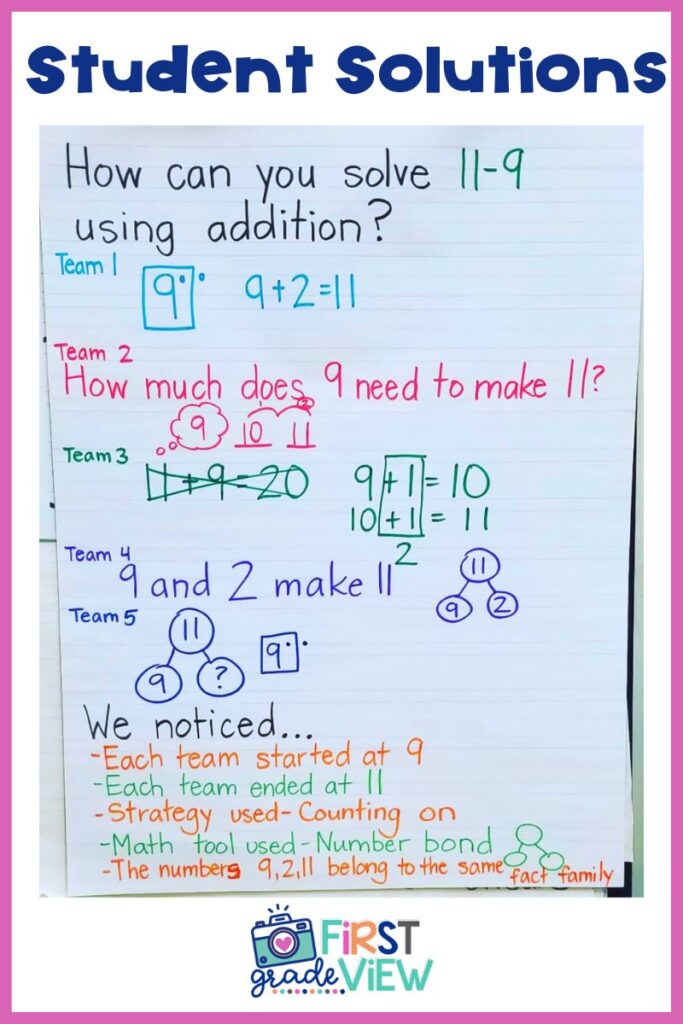
Number stories fit seamlessly into your routine through consistent use of CGI-style subtraction problems. The key is not doing them once. It is building them into your math block regularly. Consistency is everything.
How Addition Strategies Support Subtraction Skills
Subtraction does not live in isolation. And honestly? Teaching it like it does makes things harder.
Many students naturally solve subtraction problems using addition. For example, If I know 8 + ___ = 15, I can solve 15 − 8. That shift is powerful. Instead of counting backward (which can feel harder), students count up. They use what they know. They see subtraction as part of a bigger number story.
When we intentionally connect addition and subtraction, we build number sense instead of memorization. Students stop seeing subtraction as “the hard one” and start seeing it as connected math. When students work consistently with well-structured CGI subtraction word problems, they begin to see these relationships on their own.

Help Students Build Subtraction Skills that Last
At the end of the day, subtraction skills are not about how fast a student can compute. They are about understanding what is happening in a situation. Number stories slow students down in the best possible way. They help them visualize, explain, and think. When students understand the situation, the math follows.
Teacher Tip (And a Little Support If You Want It)
If you are looking for ready-to-use number stories that reflect how students actually think, my CGI subtraction word problems were designed with these exact problem types in mind.
They support:
- Result unknown problems
- Change unknown problems
- Start unknown problems

All structured in a way that builds subtraction skills without extra prep on your part.
If you want consistency across both operations, the addition and subtraction bundle makes it easy to teach them side by side so students see the connection from the start. You do not need a brand-new math curriculum. Sometimes you just need better questions. And number stories are a really good place to start.
You May Also Like:
Simple Word Problem Strategies. Teach Students to Think, Not Guess
Numberless Words Problems Made Easy
Understanding the Equal Sign: What Students Really Need to Know


