
If your students are speeding through math worksheets but can’t explain their thinking, then keep reading. As a teacher, you know you have to teach number sense but you may be looking for some fresh ideas to spruce up your routine. You may also want some low-prep ideas that are not worksheets. Well, you’re in the right place.
How to Teach Number Sense Without Worksheets
Why Ditching the Worksheets Might Be the Best Move
Is not that worksheets are bad, but they don’t always show you what your kids are really thinking. Many times, a student may have a misconception and you don’t realize it until you’re grading a whole pile of incorrect answers. Oops. The truth? Number sense isn’t built on busywork. It’s built on experience. Students learn so much through hands-on experience and from listening to their peers. You don’t need more worksheets—you need the right routines.

How to Teach Number Sense With The 120 Chart
One of my fave no-fuss routines? The 120 chart. It’s simple, powerful, and perfect for daily math warm-ups. Here are a few ways you can use the chart:
- Counting patterns
- Making predictions
- Finding missing numbers
But my students’ favorite? An activity I call “Find My Number.” For this activity, I give 4 clues that build on each other (like “start with 50+4, add the number of sides on 2 triangles, subtract 2 tens…”), and students have to find the mystery number. They love it because it feels like a game. I love it because it’s secretly spiral review, informal assessment, and number sense magic all rolled into one.

How to Teach Number Sense with Counting Routines
Another easy way to teach number sense without worksheets is through counting routines. What I love most about this idea is that it is no prep but yields high results. Plus it hits that counting standard. Here are some ways to use counting routines in your classroom:
- Counting on/back from any number
- Skip counting by 10s, 5s, 2s (starting at any number—not just zero)
- Counting by place value (e.g., 100 + 10 + 10 + 1…)
- Choral counting
These quick routines help kids internalize structure and patterns in our number system—without a single worksheet in sight.
How to Teach Number Sense With Quick Image Talks
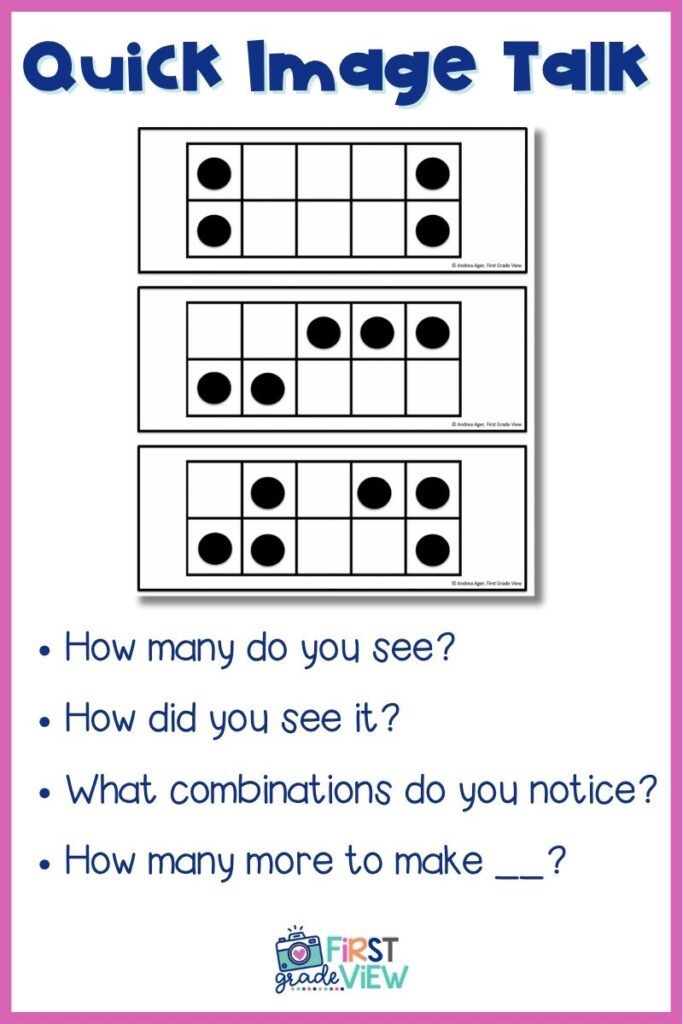
Another idea for teaching number sense is by using subitizing cards or quick image talks. Subitizing is when students can instantly recognize the quantity of a small group of items without counting them individually. Here’s an example of how you could use a quick image card with students:
Flash a dot image or ten-frame quickly—ask:
- “How many do you see?”
- “How did you see it?”
- “What combinations do you notice?”
- “How many more to make __?”
These activities build subitizing (aka: visual number sense), pattern recognition, and flexibility with numbers. Plus, it takes two minutes tops.
Building Number Sense With Math Talks with Open-Ended Prompts
Math talks are where the magic happens. Kids explain their thinking, hear other strategies, and realize—wait—I can do math in more than one way. Math talks can be specific such as, “What’s another way to make 12?” or be more open ended such as, “What’s close to 49?”
You can also use math talks to get students to try new strategies. For example, you can put up two different student solutions and simply ask, “How are these the same? How are they different?” By explaining the strategy of others, students will often try that strategy out themselves. When students justify and compare, they own the math. And that’s a win.

Build Number Sense Through Math Games with Purpose (Low-Prep Ideas)
The best math games that teach number sense focus on strategy, reasoning, and conversation—not just winning. These don’t have to be fancy! Trust me, I’m all about that low-prep life. A few easy games that don’t take a lot of prep are card games, dice games, or spinners. Use dice, spinners, or playing cards to play:
- Roll and Compare
- “Make 10” with cards
- “Race to 100” on a 100 chart
How to Build Number Sense with Manipulatives
Last but not least, you can use your math manipulatives to give students hands-on experiences to build their number sense. Remember, hands-on learning is real learning. You will want to use the manipulatives strategically. For example, when working with number bonds, using unifix cubes can be very helpful in helping kids see the total and the parts. Here are a few other ways you can use manipulatives. Grab base ten blocks, cubes, or counters and say:
- “Show me 36 two ways”
- “Build 25, now add 10—what changed?”
- “What number has 4 tens and 2 ones?”
These activities turn abstract ideas into something they can see and touch. And that builds real number sense.

How to Build Number Sense Without Worksheets Last Thoughts
You don’t need a stack of worksheets—you need consistent, meaningful number sense routines that help students see the math. Try just one of these ideas next week. See how your students respond. Then build from there. You’ve got this!
Want a Done-for-You 120 Chart Routine?
Grab my Building Number Sense with the 120 Chart resource for daily warm-ups and math talks that actually build number sense.Not ready to commit? Snag 2 weeks free and try it out with your class.
You May also Like:
What’s a Number Sense Routine? And Why It’ll Be Your Secret Weapon Next Year
120 Chart Number Sense Routine
Number Sense Superstars: Building Number Sense in First Grade


